
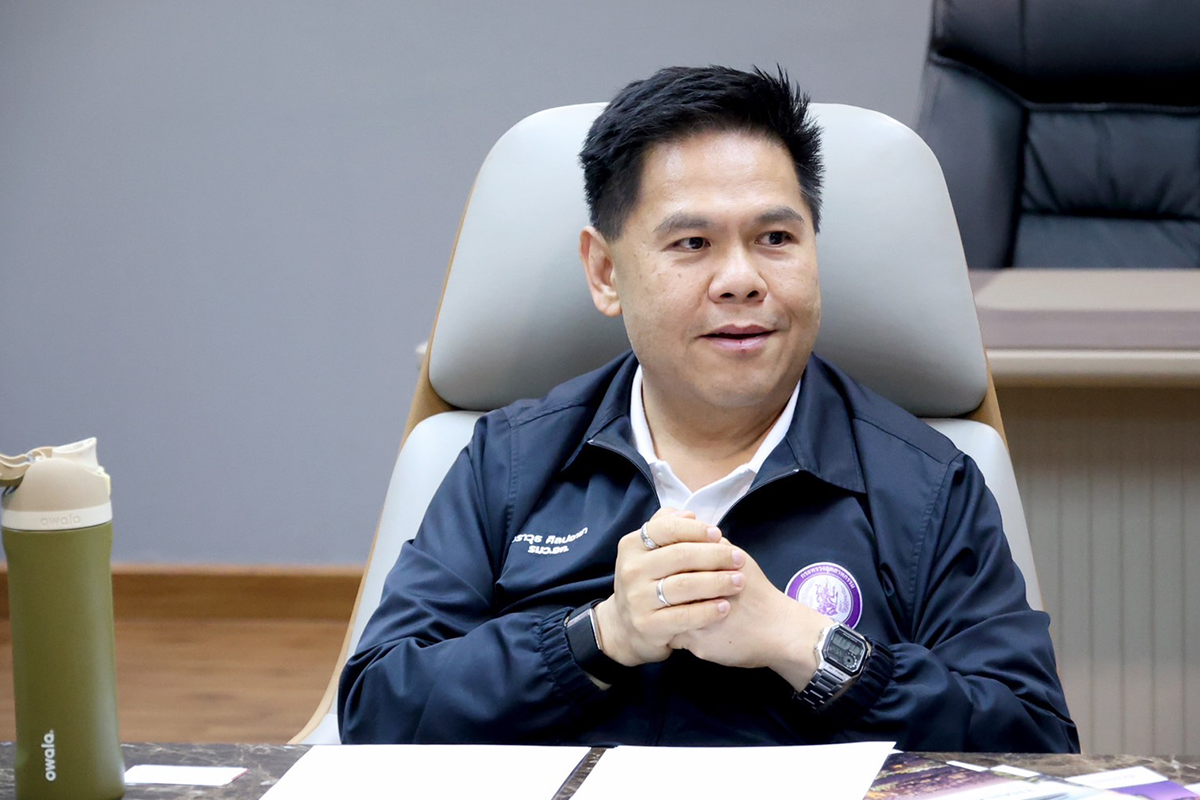
25 Sep Interview with H.E. Varawut Silpa-archa, Minister of Industry, Thailand
At the recent Bangkok Business Summit, you outlined how Thailand’s Sufficiency Economy Philosophy can help address the K-shaped divide within the country’s industrial economy. How can Thailand bridge the gap between traditional sectors such as agriculture and manufacturing and the rapid growth of new high-tech industries to create more balanced and sustainable growth?
Thailand has a K-shaped economy, which is a bit of a concern. One branch keeps rising, driven by advanced industries such as semiconductors, Printed Circuit Board Assembly and photonics. The other branch including traditional industries falls further behind. Thailand must not be on that downward path. I believe that while some countries have their resources underground—oil and rare earths – Thailand’s “oil,” is above the ground. It is renewed with every harvest. There is a Thai proverb: “An army marches on its stomach.” In Thailand, we make food, not war. We have food security, fertile land, abundant water and a strategic location at the heart of Southeast Asia. These are our strengths.
Unlike the downward branch of the K-shaped economy, they give Thailand a foundation for sustainable and inclusive growth. Exports have grown significantly: they increased from $8.5 billion in 2023 to $10.2 billion baht in 2025, representing around 12 percent year-on-year growth. Our electronics sector grew by 21.6 percent, with computers and electronic equipment accounting for 63% of that growth. This is driving the upper branch of our K-shaped economy, particularly in photonics, where investments from companies around the world are increasing rapidly. Thailand’s largest electronics company, Delta Electronics Thailand, expects revenue of around $9.5 billion this year. Clearly, the upper branch of Thailand’s K is rising very strongly. It is driven by two ‘AIs:’ the first is advanced industry, the other is the agriculture industry and that is Thailand’s strength. We have always been an agricultural country, with deep local knowledge and expertise. We need to integrate this strength with advanced industries. That is why I call it the “AI Square” policy—Advanced Industry + Agriculture Industry.
Agriculture contributes less than 10 percent of our GDP, but employs around 30 percent of our workforce. We need to close that gap by creating higher-value products. We should not simply export rice; we should process it into products with much greater value. The same applies to sugarcane, which can be developed into sugar, ethanol and other high-value products. If we can raise agriculture’s contribution to 20–30 percent of GDP, while supporting the workforce that depends on it, we will create a much stronger economic foundation. A stronger foundation means stronger SMEs and industries. So, my AI Squared policy is about using new technologies while maximizing Thailand’s existing strengths.
Thailand has long been known as the “Detroit of Southeast Asia” for the strength of its automotive industry. You recently met with the President of Nissan Thailand to discuss the country’s role as a manufacturing and export hub within ASEAN. At the same time, Thailand is attracting major investment into emerging industries such as electronics, data centers, cloud services and AI-driven digital infrastructure. How is Thailand’s automotive industry transforming to meet changing global demand and maintain its competitiveness as the sector moves towards electric vehicles (EVs) and more energy-efficient vehicles?
Japanese automotive companies such as Toyota, Nissan and Mitsubishi have invested in Thailand for decades—Toyota for over 60 years and Nissan for around 70. They did much more than build factories. They developed upstream, midstream and downstream supply chains, creating a strong automotive ecosystem. That supply-chain strength remains one of Thailand’s biggest advantages in attracting foreign investment: it is efficient, modern and reliable. Thanks to these Japanese partners, Thailand became known as the “Detroit of Asia.” We have shared the good times and now we are facing a challenging period as Chinese EVs enter the market and technology changes.
We cannot simply abandon a lifelong partner. It is like a marriage. After 60 or 70 years together, we may hit a few potholes, but we need to work through them together. The first thing I tell them is: we will not leave you behind. The Thai government will support you as the industry adjusts. We are also adjusting the excise tax to help level the playing field. The automotive industry is changing rapidly. Today, more than 50 percentof vehicles sold in Thailand are XEVs, and around 30% of those are fully electric. Companies such as Toyota and Nissan will need to evolve with new technologies, but there will still be a place for internal combustion engines (ICEs). Our role is to give them enough time and support to make that transition. Thailand is also a major export base for Japanese automakers, so they will continue to need Thailand to produce vehicles for markets around the world—including ICE vehicles.
Thailand is moving toward green industries, clean energy, solar cells and EVs and Japanese automakers are adapting alongside us. Our SMEs and supply chains must evolve with them. The most important message I have given them is: we will not leave you behind. The government is taking concrete steps, including a localized production mandate. For every EV imported, manufacturers must produce two vehicles locally—and next year, that will increase to three. We are also increasing local content requirements to keep our supply chains strong and ensure technology continues to develop here. The industry is changing, but our message to Japanese companies—and to our long-term partners—is clear: we will walk hand in hand through this challenge, because every crisis also creates new opportunities.
In May, the Board of Investment of Thailand (BOI) approved six major projects worth around $29 billion, largely in the technology sector and led by major data infrastructure investment from TikTok. Beyond automotive, which emerging industries does Thailand see becoming major economic pillars in the years ahead and how is the government encouraging investment in these sectors?
Beyond advanced industries, we also see strong potential in healthcare, medical services and the longevity economy. Thailand is an aged society and is moving toward a super-aged society faster than expected. This makes the silver economy increasingly important. It is not just about keeping older people in the workforce; it is about developing industries and technologies that improve their quality of life. For example, technologies such as exoskeletons can help older people remain active and independent. We want to ensure that people can age with dignity, both physically and mentally. That is why healthcare, medical and longevity industries, together with agriculture, will be key sectors for Thailand’s future.
Another crucial area is recycling. I am passionate about establishing a recycling industrial estate in Thailand, similar to those in Japan. The world is investing heavily in solar cells and EVs, but we also have to think about what happens at the end of their life. Solar panels contain glass and aluminum that can be recycled, but the photovoltaic cells themselves are still difficult to recycle. We need to develop technologies to deal with this growing electronic waste. The same applies to EV batteries. After around 10 years, when they are no longer effective for fast charging, they can be repurposed for energy storage systems. But eventually, we also need to recycle them and recover lithium and other valuable metals. This is where urban mining can create a new, value-added industry for Thailand.
Thailand is expanding policies and tax benefits to strengthen industrial competitiveness and attract investment, including the recent extension of factory fee exemptions in the southern border provinces. What flagship policies are being introduced to reduce costs and bureaucracy and make Thailand more competitive for businesses and what further reforms will be needed to drive innovation?
This is our prime minister’s number-one priority. He has given us a clear mandate: get things done quickly. That is why we introduced the Thailand Fast Pass. The BOI is speeding up investment approvals and at the Ministry of Industry, we have streamlined factory approvals with a target of completing the process within one month. We have also changed the approach. Instead of making investors wait until every requirement is completed before granting a permit, we allow them to proceed, provided they meet all the requirements. If we inspect the factory and find that they have violated the rules, we will shut it down.
At the same time, ease of doing business does not mean compromising the environment. We are working with the relevant agencies to make illegal industrial waste dumping a serious financial offence, including asset confiscation. No amount of money can restore a polluted lake or damaged environment. Our goal is simple: attract quality industries, make it easy to do business and protect our people and our environment.
Thailand recently launched its THAILAND² program to develop human capital at all stages of life. At the launch, Prime Minister Anutin Charnvirakul highlighted four major challenges facing Thailand and its education and R&D sectors: an ageing population, technological disruption, geopolitical volatility and environmental pressures and climate change. As Thailand attracts more high-tech investment, how are national education and training programs helping align workforce capabilities with the needs of emerging industries? What more is required to develop the human capital needed to achieve the country’s 12-year ambitions?
The automotive industry is a good example of how technology is changing everything. In the past, you opened the bonnet and saw an engine—pistons, cylinders and all the mechanical parts. Today, you open it and find a frunk. A car is no longer just a machine; it is a computer on wheels. As vehicles become more electric and software-driven, our education system and workforce must evolve with them. That is why the Ministry of Industry is working closely with the Ministries of Labor, Education and Higher Education, as well as the BOI, to prepare both our future and current workforce.
Thailand is an aged society, so upskilling and reskilling are essential. We need to make the most of the experience and knowledge of older workers while preparing younger generations for new technologies, including AI. This collaboration is critical to building the workforce Thailand needs for the industries of the future.
Growing SMEs is a major focus of Thailand’s current economic strategy. In December, the government approved an $8 billion support package for small businesses. Thailand is also deploying its TISI 9999 corporate management standard to help SMEs apply Sufficiency Economy Philosophy principles and build greater resilience. What recent measures are helping entrepreneurs and SMEs scale and integrate more deeply into Thailand’s industrial value chains and why are these businesses so important to the country’s long-term economic success?
Thailand has just over three million SMEs, contributing nearly 35 percent of GDP. They are the middle of our economic pyramid and I believe they have been overlooked for too long. Government support has traditionally focused either on the base—farmers and low-income communities—or on large industries at the top. However, SMEs are critical to the economy and generate a significant share of tax revenue. Their strength is Thailand’s strength and strengthening them will directly increase GDP. That is why, through the Ministry of Industry, we have the SME Development Bank. Unlike a typical commercial bank, its primary purpose is not simply to make profits, but to support and strengthen our SMEs. Our measure of success is not profit—it is how many SMEs survive and grow through these changes.
Since April, our SME Development Bank has provided around $600 million in loans, with about $330 million already disbursed. These loans are offered at very competitive rates. For example, our Green Transition Loan allows SMEs to borrow up to $27 million for projects such as installing solar panels or switching logistics vehicles to EVs. The loan can run for 10–15 years, with an interest rate of just three percent for the first three years, before moving to the minimum lending rate. Our goal is not to make money. Our goal is to make sure our SMEs survive, transform and remain competitive. The second type of support is to help SMEs with cash-flow problems. Some businesses are fundamentally healthy but need temporary support, so we can lend them up to $1.5 million to keep them afloat. The third is debt restructuring. We can reduce interest rates, extend repayment terms or provide a haircut to help viable SMEs recover.
Supporting SMEs is not just about money. Today, they also face new international requirements such as the Carbon Border Adjustment Mechanism (CBAM), the EU Deforestation Regulation and Europe’s Cyber Resilience Act. Many SMEs are simply not aware of these regulations. We need to help them understand and meet these new standards if they want to compete in global markets. Many SMEs do not even know what CBAM is or how to measure their carbon footprint. Certification costs money, so it can feel like a burden. But in reality, it is your passport to the world—your ticket to selling in Europe, the U.S. and other global markets. Our job is to make sure SMEs understand these new rules and standards and help them upgrade their production.
ESG is now becoming a key part of Thai industrial standards. We need to help our SMEs meet these standards and remain competitive globally. I have worked across all three areas of ESG: environmental, social and governance. Thailand also has its own standard, TIS 9999, based on the Sufficiency Economy Philosophy (SEP) bestowed upon us by His Majesty King Bhumibol Adulyadej Rama IX. This philosophy dates back to 1975, long before the UN’s 17 Sustainable Development Goals. It balances three dimensions: the economy, the environment and society. We have translated these principles into TIS 9999 to help SMEs adapt to technological disruption and remain sustainable. The focus is not simply on profit, but on building businesses that can survive, grow and contribute positively to their communities and the environment.
Another major area of transformation is sustainability, reflected in Thailand’s Bio-Circular-Green Economy Framework and its focus on developing a more circular and green economy. As the country moves towards carbon neutrality by 2050, the government is promoting recycled plastics and bio-based materials through cross-ministry collaboration while supporting the growth of green industries such as cleantech and renewables. What opportunities are opening up for investors and local businesses as this transition accelerates?
We start with the SEP and connect it to today’s ESG principles. We then put ESG into practice through the Bio-Circular-Green Economy. The bio-economy is particularly important for Thailand. For example, the government is moving toward E20 and B20 as new national fuel standards. This will boost ethanol, biodiesel and palm-oil production, creating more opportunities for our farmers. Biofuels can also strengthen our energy security by reducing our dependence on imported energy. This includes sustainable aviation fuel which will also be an important part of Thailand’s future. We already have large factories in Thailand that convert ethanol into polypeptides, which can be used as raw materials for biodegradable plastics.
In the circular economy, my goal is to establish a recycling industrial estate in Thailand. We already have a pilot closed-loop industrial estate in Map Ta Phut, where the aim is to achieve zero industrial waste. One factory’s waste becomes another factory’s raw material. If successful, we will scale this model nationwide. It will reduce the use of virgin raw materials, lower our dependence on crude oil and create a truly circular industrial economy. I actually started working on this when I was Minister of Natural Resources and Environment, with our campaign to say no to single-use plastic bags. It was not always popular because people value convenience, but today the need for a circular economy is clearer than ever. There is always an opportunity in a crisis and for us, it is the green economy.
The government’s biggest mandate is to transform Thailand into a green industrial economy. We have approved a $12 billion-scheme, with $6 billion dedicated to the green-energy transition. We plan to install rooftop solar panels for 1.5 to 2 million households, allowing them to sell excess electricity back to the grid. We have also reformed our long-standing power-purchasing arrangements to allow individuals to both sell electricity and buy it from third parties. It was a courageous move, but an important one for the green economy and our Bio-Circular-Green (BCG) Economy strategy. At the Ministry of Industry, our Green Industry Award takes factories from Level 1—having a policy—to Level 5, where they create shared value, not just CSR. Around 60,000 of Thailand’s 70,000 factories have already reached these standards. We have only about 10,000 left. We can proudly say that Thailand is truly transforming into a green industrial country.
The USA was Thailand’s second-largest trading partner in 2025, with Thai exports to the USA reaching $71 billion baht. While US tariffs have created disruption, the two countries are working closely to finalize the Thailand–US Agreement on Reciprocal Trade. Amid major shifts in the global economy, how has Thailand’s economic relationship with the USA evolved in recent years and where do you see the strongest opportunities for greater U.S. investment and participation in Thailand’s industrial growth?
I feel sorry for Americans because tariffs will make everything more expensive. Thailand and the U.S. have been long-standing trading partners and we will continue to trade because the U.S. is a huge consumer market and will still need products from Thailand. At the same time, the Agreement on Reciprocal Trade forces everyone—not just Thailand—to step outside their comfort zone. There is always a silver lining in a crisis. It has made us realize that many other markets also want Thai products. We simply need to work harder to find those markets while maintaining our strong trade relationship with the US.
All countries are facing the same challenges. I recently spoke with a European ambassador who said their country has a trade deficit with the U.S., and they still got hit with tariffs. The whole world is being pushed into a new era of international trade. We have to step outside our comfort zone and find new ways to compete. For Thailand, that means diversifying our production, investment and trading partners while continuing to maintain our strong trade relationship with the U.S.
You have built a distinguished career in public service before becoming Minister of Industry, including serving as Deputy Minister of Transport, Minister of Natural Resources and Environment and Minister of Social Development and Human Security. As the newly appointed Minister of Industry, what are your top priorities and what lasting impact would you like to have on Thailand’s industrial development?
For me, sustainability is about much more than being green. It means making sure what we do today can last for decades, benefits local communities and leaves no one behind. Industrial development is not just about how much money is invested, but how much knowledge and value stays in Thailand. How do Thai people benefit from FDI? How does it improve their lives and strengthen our economy in the long term? It is about what you bring to Thailand and what you build with us—not just for yourself—through strong local supply chains and partnerships. I do not want to simply make the pyramid taller. I want to lift the bottom up and make sure everyone moves forward together. That is my top priority.
What’s your final message to the readers of Newsweek?
Thailand is transforming alongside the world. We are at the heart of Southeast Asia, we love peace, we make food—not war—and we have “oil on the ground.” Through our AI Squared strategy, we have more than 80 industrial estates, modern ports and digital infrastructure, with strong and reliable energy supplies.
We also have something equally important: our people and our hospitality. If you are looking for a safe and stable place to invest, especially during times of geopolitical uncertainty, come to Thailand. We fight with no one. Our strength is in our land and our people. As the world faces new trade barriers and embraces ESG and BCG, remember that Thailand has had the SEP for more than 50 years. As Minister of Industry, my responsibility is to protect our land and environment while ensuring our industrial partners prosper. Come to Thailand. We have everything ready.