
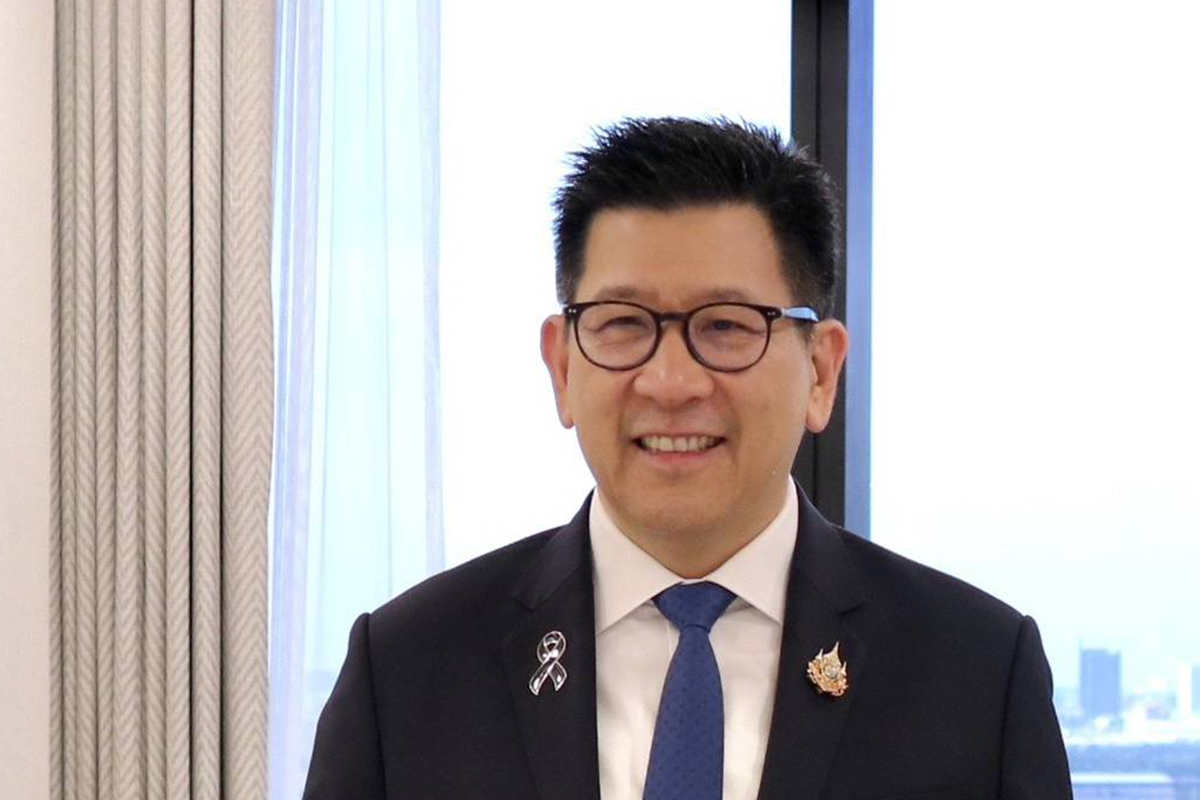
25 Sep Interview with H.E. Dr. Ekniti Nitithanprapas, Deputy Prime Minister and Minister of Finance of Thailand
Thailand’s GDP reached $577 billion in 2025 following annual growth of 2.4 percent. Despite a challenging global environment, the IMF recently raised its 2026 growth forecast to 1.9 percent. Record investment, stronger fiscal discipline and a renewed focus on competitiveness are also building new economic momentum. Can you give Newsweek readers an overview of how Thailand’s economy has developed in recent years and what makes it stand out in Southeast Asia?
Thailand is located in the center of the Association of Southeast Asian Nations (ASEAN) and during the past 10 or 20 years, we have achieved economic stability. Before the 1997 financial crisis, we grew very rapidly, which in part led to the crisis of 1997. After 1997, growth slowed down but we achieved economic stability as the foundation. During the past 10-20 years we have faced a lot of crises like the global financial crisis in 2007-2008, then the European crisis and then COVID-19 and political instability.
Having assumed my duty as deputy prime minister and finance minister, what I’m trying to do is to understand the foundation of the Thai economy and try to fix the things that we should have done. We have had strong foundations and we have to maintain that economic and financial stability. We have stable international reserves of more than two times short-term external debt and covering around 10 months of import. That’s why the Thai baht is very stable.
On the financial front, we have a strong banking system, we have a capital adequacy ratio of almost 20 percent on average, which is more than the requirement of the Bank of Thailand and Bank of International Settlements standards, which is around 10 percent. On public sector stability, we are still very strong even though we have had a number of crises when we had to use a lot of public expenditures to support people during COVID-19. But public debt to GDP is still around 67 percent which is much lower than many countries. That’s how we could survive the external shocks we faced. However, our economic growth is slowing down. To some extent, it’s related to political instabilities during the past 10-12 years. However, with this government and its coalition parties with a clear mandate from the people, we can hopefully do something to make Thailand go back to the high growth path. The key idea is the investment. Investment is on my top list of priorities to drive the Thai economy forward.
Before the 1997 financial crisis investment to GDP in Thailand was around 40 percent of GDP, which might be considered too high and that’s why we had the financial crisis, but afterwards the investment ratio to GDP has come down while other countries like South Korea and Indonesia, who had the same crisis, investment is going back to the same level. That’s why my initial target for Thai government policies is to push the investment to GDP ratio back to 30 percent within four years from 23 percent currently. I consider investment to be the source of growth: if you want to grow further in the long run you need investment. When you consume you enjoy it but it’s all gone eventually, whereas if you invest, it not only stimulates your current economic growth but also supports long-term economic growth, increasing capacity. That’s why I put investment as my top priority.
You recently outlined Thailand’s 4T policy framework during the IMF spring meeting in Washington DC. Can you explain the 4T framework and how it is being used to shape Thailand’s future economy and deliver long-term benefits for citizens and businesses?
When I spoke at the Global Dialogue at the IMF World Bank Spring Meeting, all countries were facing the same problem because of the Middle East crisis. In that conference, we discussed our policy and how to handle it. I mentioned to global leaders our 4T Policy Framework. T one is Targeted support, because the Middle East crisis affects a number of countries through rising oil prices, rising cost of living and especially those who have been affected the most, who were vulnerable people. Every country after COVID-19 has limited fiscal space, so we need targeted support, not broad-based financial support to everyone.
The second T is Transition to clean energy. Rising oil prices coming from the crisis in the Middle East affect global oil prices which is still ongoing. We now live in another world because major infrastructures in the Middle East of the oil and gas industries have been destroyed. We have to make transitions and use these opportunities to make faster transitions. The third T is economic Transformation. We need to transform on many issues. Investment is one area, but also clean energy infrastructures, human capital and skill. That’s very important for using public spending or fiscal space to transform for the longer term. The final one is Transparency which is so important because in order to have public involvement in terms of transition and transformation, you need to do it in a transparent manner. Open up the data for the people to see and to understand.
Thailand recently unveiled an ambitious 12-year economic strategy aimed at breaking out of the middle-income trap and strengthening the country’s global competitiveness. The strategy is built around three key pillars: maintaining fiscal stability, developing national infrastructure and accelerating targeted industrial growth. How do these three pillars come together in Thailand’s new 12-year economic blueprint and what concrete steps are required to achieve its ambitious goals?
We have seen some flows of investment coming to Thailand on particular industries. As chairman of the board of investment, I can also say that we had a lot of applications for FDI coming to Thailand requesting for incentives. There are six or seven sectors where Thailand is very popular.
The first sector is smart agriculture and food processing. As Thailand started 80 years ago as an agricultural country, we have strong foundations in this sector. With technology, smart agriculture started to take off and the sector is moving to the next level: the factory—farm, food, factory is the process. This is combining into smart agriculture and food processing. Thailand is really strong on food processing, including pet food which is very popular. We receive a lot of investment applications from foreign companies in food processing industries and in pet food where we are in the top five in the world.
The second sector is smart digital. In the 1980s, we received a lot of FDI in the electronics sector. We are very good with air conditioners, computers and laptops. In the past, we were very good at producing servers and now we are one of the top producers of servers for AI industries. We receive a lot of attention on expanding from simple electronics sectors to smart electronics and AI. With AI rising and data multiplying, it requires a huge server. The top two or three servers around the world are produced in Thailand. Also coming to Thailand are optical transceivers—the top two of the world are produced in Thailand.
The third sector is smart automation. Thailand has been very good in producing cars in the automotive sector. A number of global companies started using Thailand as a base. With the development of electric vehicles (EVs), we need to transition from internal combustion units to EV and we have started to receive a lot of attention on investment on EVs and supply chains like sensors. In the service sectors, Thailand is very good in healthcare and wellbeing. We were very good during COVID-19—one of the best countries handling COVID customers and clients—and we are very good in wellness – not only services but also the production of new machines related to medical sectors.
Another service sector that we are very good at is tourism, from low value tourism to high value tourism like medical wellness. We receive a lot of attention from clients from the Middle East and from rich countries around the world coming to Thailand to have medical services here in Thailand.
Thailand hit a new record for investment applications in the first half of 2026 supported by initiatives such as the government’s FastPass program, reaching $44.2 billion across 1,299 projects. The country is also advancing its BOI to IPO strategy to encourage foreign-invested companies to participate more deeply in the domestic capital market. What are the main objectives of the BOI to IPO strategy and how will it encourage foreign-invested companies to list on the Stock Exchange of Thailand and deepen their participation in the domestic economy?
With the crisis in the Middle East and the global economic situation at the moment, this is a fragmented world. People want to have a safe and secure place to invest. Thailand is one of the target destinations. That’s why we receive a lot of applications. Thailand offers investors stability but also, Thailand can trade with everyone. We are very secure.
The question is how can we make that investment beneficial to Thai people and companies? That’s why I plan to apply incentives and requirements for companies investing in Thailand to transfer knowledge and technologies to Thai people and to companies—using local companies in supply chains. It happened before in the automotive sector. In the 1980s when Japanese and German companies began investing in Thailand, we didn’t have a lot of supply chains at the beginning, but now we have very deep supply chains. We have to do the same with the new technologies and AI. That’s why we asked investors to bridge these new skills to Thai people. Making people better and providing higher quality jobs.
Those companies investing in Thailand need to use capital to invest. Rather than having capital from outside Thailand’s financial markets, we would prefer to raise financing on the capital market. We have a very good banking system, a very good digital system and electronic payments that are one of the top five in the world, so we will use that advantage and deepen our capital market. We are designing special programs called Board of Investment to Initial Public Offering (BOI to IPO), so companies investing in Thailand need local Thai Baht, you can also be listed in Stock Exchange of Thailand. I link BOI and the Stock Exchange of Thailand together.
Drawing from your pioneering the PPP Fast Track and the Thailand Future Fund, how are you utilizing modern financial instruments to catalyze private sector participation in key infrastructure projects amid global macroeconomic volatility?
I plan to use investment as the new source of growth for infrastructure investment. It’s called investment-led growth policy. But to finance it on public infrastructure, you need to use public debt and public borrowing. But we have limited space and I would like to ensure fiscal stability. On the other hand, we have plenty of reserves. In the banking system, we have excess liquidity—around $90 billion—so, with that being the case, why don’t we use the infrastructure fund to attract investment?
The private sector wants to invest in long-term infrastructure projects. For example, we would like to make Thailand transition to clean energy. We need to expand the grid. So, rather than borrowing from public sectors, use that as a mechanism to involve the stock exchange of Thailand to be the source of funds. PPP is the same concept: rather than government public sector investing alone, bringing in private sectors to be partners.
Thailand is undergoing a sweeping fiscal and tax modernization driven by its ambition to align with OECD. Can you explain your digital transformations across the Revenue and Excise Departments and how your digital-first approach to public finance is enhancing tax transparency, targeting illicit financial flows and broadening the national tax base?
In my previous roles in the public sector, I was head of the revenue department and exercise tax department. Back then I used a lot of digital technologies to expand the tax base, but my goal is to make tax easier for people. It’s similar to every country. People don’t want to pay tax, but if it’s difficult, it’s even worse. The first thing you need is to make tax easier. Luckily, we have digital technologies to support this agenda. I’m sure that filing tax in Thailand is much easier than many countries in the Western world because we are using digital technologies and AI to help people to file taxes. The result is that the tax base is extended and that’s why I think digital technology is very useful and with the rise of AI, it will even help tax and revenue departments to be better.
I plan to use the same strategies using digital and AI to help Thai people not only to pay tax but also to support their life. One of my key priorities is to stabilize policies and with the Middle East crisis and rising costs and rising energy prices, we need to support low-income, vulnerable people and small merchants along the street. We now have AI-embedded programs in smartphones so that small merchants selling food on the street have programs to help them analyze items, what’s the most wanted item, etc., so they can manage their stocks easier. Those small merchants use a lot of informal lending so I asked financial institutions to be more inclusive—with the consent of the small merchants—so that they can easily get better and cheaper finance from financial institutions. That’s using AI to support people and also training them to use online.
Since becoming finance minister, you have championed an industrial transformation aimed at making Thailand more resilient to external shocks and positioning the country as a high-value technology hub. How is the government accelerating Thailand’s renewable energy transition and what new opportunities could this create for businesses, investment and employment?
For the energy transition, we need more clean energy. Right now, 65 percent of electricity is from liquefied natural gas, which is a fossil fuel, so we need to change that to renewable energies. We need to invest a lot in clean energy like solar farms and floating solar. That’s why we have a power development plan. In terms of production, we plan to change the way of producing electricity. Rather than only having state enterprises to produce electricity, we will give subsidies to low and middle income people to set up solar on their rooftops and change them from consumers to the so-called pre-sumers so that they can sell their electricity back to the grids and generate income from their rooftop. This will lower their cost of living by paying cheaper electricity bills.
Another area is oil and gas. We import a lot of oil, especially from the Middle East. Half of the imported oil comes from the Middle East. Because of rising oil prices, our bills are higher. Our credit account turned from surplus to deficit within one quarter. Unfortunately, we don’t have oil on the ground, but we do have ethanol from agricultural sectors, we have palm oil which can mix with diesel to use buses and in some automotive vehicles so we will use policies to encourage people to have more vehicles using renewable energies.
Thailand will host the IMF–World Bank Group Annual Meetings in Bangkok in October 2026 under the theme “Thailand’s New Horizons: Empowering People, Building Resilience.” The meetings will bring global economic leaders together to strengthen international cooperation and sustainable growth amid continued global uncertainty. What factors gave the IMF and World Bank Group confidence in selecting Thailand to host one of the world’s most important economic gatherings?
Thailand is located in the very center of ASEAN and Asia, we have had strong economic and financial stability as well as security stability. That’s why people voted for Thailand to host the annual meeting for the second time. I think only three countries in the world have had the opportunity to host the annual meeting two times. Other than geographical locations, we offer top-notch incentives. We are very good at tourism—we have a number of five star hotels, Thailand is so famous in terms of tourism.
Because of new geopolitics and geoeconomics currently happening in the fragmented world, people want a safer and secure place and Thailand can offer not only tourist destinations, but we can be a business hub and our strategy is to be a trusted connector to the world. That’s why the country message and theme that we offer to the World Bank that as a host we are able to launch the host country programs.
We set the agenda even before the Middle East crisis and called it Entering the New Horizons. I believe that everyone knows that we are all entering the New Horizons with the fragmented world, geopolitics, geoeconomics, with the rising technologies, AI, changing so many dimensions, both good and bad. We have to deal with the new era and climate change. Climate change and climate adaptation is so important. That’s why we are putting it as the top agenda of country programs. The second theme is empowering people to deal with these challenges. The keywords of the event are building resilience and making sure that people are resilient to shocks. That’s why we have chosen new horizons, employing people and building resilience as the key major themes that we offer to the world. We can be thought leaders. It’s not just geographical location but also the concept, the ideas.
How is Thailand preparing to welcome delegates from around the world and what impact do you expect the meetings to have in raising the country’s profile and showcasing its economic and investment opportunities globally?
Around 15,000 people will be coming to Thailand, including many global leaders, economics and finance figureheads. They will come to see us on the ground and see how vibrant Thailand is and what we can offer. Thai business leaders will also join some conferences and this will create opportunities for further investment in Thailand. We plan to offer Thai products and services from all over the country. We will represent different cultures from different parts of Thailand and Thailand will be in the spotlight again.
What’s your final message to our viewers?
Thailand has lots of opportunities, not just within our borders but also through the free trade agreements (FTA) that we have among ASEAN so Thailand makes a powerful hub or springboard to any ASEAN countries and to the world. We have a number of FTA with Australia and New Zealand, that’s why a number of automotive companies use Thailand as a base to ship their car productions to Australia and New Zealand. Also we are expanding FTAs of Thailand using Thailand as the hub of economic and internal stability. Thailand makes a secure place for your investment with a lot of high quality products and services.
Aside from investors or businessmen, Thailand can offer a number of things. Tourism is one area. Thailand is well known for tourism. You can come and enjoy our hospitality. People cannot be considered as locals, but can be global citizens, so consider Thailand as a way to enjoy and to see. When you come and work in Thailand, you come not just to produce, but do some business with Thailand.